
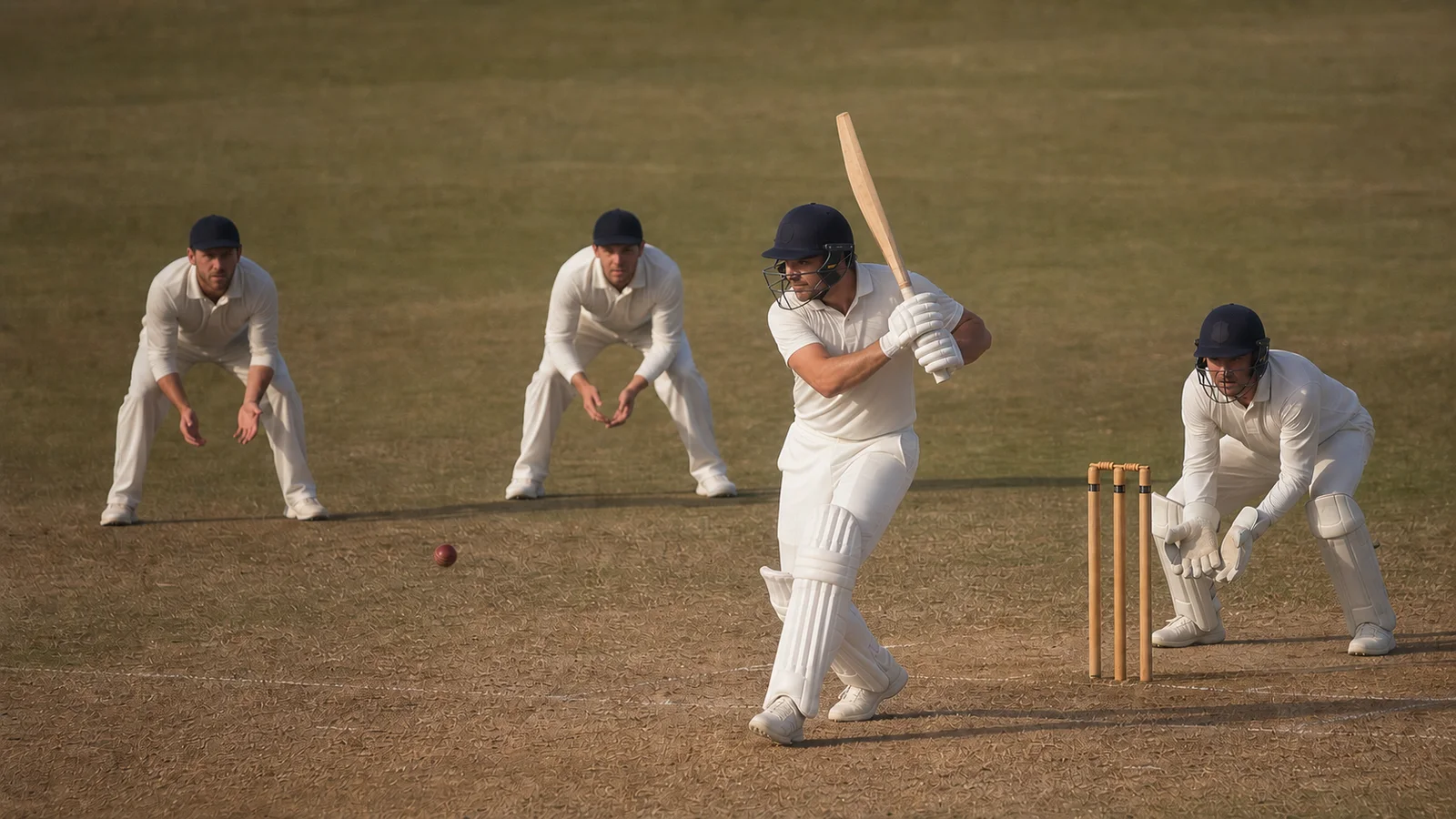
Read the match before taking guard
Read score, wickets, lead or deficit, overs and time before taking guard. Identify ball age, surface pace, weather, current bowlers, field and the partner's state. A batter entering at 20 for 3 has a different risk budget from one arriving at 280 for 3; a fourth-innings target changes the cost of every dot. The best toss decision in cricket explains the starting choice, not the present answer. State the immediate team task in one sentence: survive the new ball together, rebuild to lunch, erase the deficit or score quickly enough to leave time for twenty wickets.
Use the first balls to reduce uncertainty
Use early deliveries to reduce uncertainty without assuming they must all be defended. Watch release, length cues, pace, bounce, swing, seam and the keeper's take. Track which ball threatens off stump and which can be left. Research by Brewer and later survival work supports the idea that batters often perform differently near the start, but it does not prescribe a universal twenty-ball incubation. Some adjust quickly; conditions can also remain difficult all day. The best use of the new ball in cricket describes the bowler's information window; the batter is running the same experiment from the other end.
Build a dismissal map
Build a dismissal map for each bowler. Against seam, list outside edge, inside edge or lbw, bowled and short-ball routes; against spin, include outside edge, bat-pad, stumping, lbw and miscued attack. Rank them by today's evidence rather than reputation. Then remove the easiest route through guard, trigger, leave, line choice or shot restraint. Do not try to eliminate every risk at once. The greatest fast bowlers of all time could threaten both edges, so the batter may need a narrower scoring map until line or ball condition changes.
Make the leave and defence active choices
A leave is active when the batter judges off stump late, stays balanced and can withdraw the bat without following movement. Defence is active when head, hands and contact keep the ball controlled rather than merely blocking with tension. Play straight enough for the live threat; soften hands when edge carry matters and use decisive footwork when length allows. Rehearse where a defensive ball should finish. A leave based on premeditation rather than line can expose off stump, while a hard defensive push can carry to catchers. Judge quality from control, not whether the ball happened to miss the edge.
Protect one safe scoring option
Protect one safe scoring option from the start. It may be a straight push, clip, back-foot punch or controlled single into a known gap. Scoring forces field and length decisions and prevents every dot from increasing pressure, but the option must fit the ball. The best way to rotate strike in cricket links contact, calling and field margin; it does not require a run from a good defensive delivery. Expand to a second option only after the first remains controlled. The greatest batsmen of all time differed in style, yet long innings generally needed both wicket protection and a way to keep the scoreboard alive.
Build the partnership as an information system
Treat the partnership as an information system. Between overs, exchange short facts: pace is slower than it looks, ball is holding, spinner is drifting, deep point has moved, or one end has more bounce. Do not ask the partner to copy a method that does not fit. Define who is managing risk and what score or time block matters next. The best batting partnerships of all time are rankings material requiring human judgment, but the practical lesson is non-ranking: two compatible plans can cover more conditions than two isolated innings.
Reset at every meaningful change
Reset when the problem changes. Walk away, breathe, look at the field, restate dismissal and scoring maps, then recommit. Use this after wickets, boundaries, bowling changes, end changes, drinks, lunch, rain, treatment, milestones and long delays. A reset is not a performance ritual that guarantees concentration; it is a structured re-check. After an interval, the batter remains not out but may have lost visual calibration while the ball, light or bowler has changed. Treat the first few balls as a smaller entry phase without surrendering every scoring opportunity.
Manage concentration without chasing it
Concentration cannot be held at one maximum level for six hours. Narrow attention to the bowler's run-up and release, then switch off safely between balls. Use consistent guard checks and breathing only if they help return attention to the next delivery. Do not replay a play-and-miss for an over or project a century at 37. Fatigue, noise and frustration are information: slow the routine, hydrate at permitted breaks and simplify choices. Sport psychology claims should not be invented; the public framework is behavioural and observable, not a promise that one mental trick prevents dismissal.
Bat through the first new-ball cycle
Through the first new-ball cycle, make the bowlers repeat quality. Leave width, control straight balls and punish only the scoring errors the batter owns. As movement falls, expand in small steps rather than assuming the ball is now harmless. A change of bowler can restore threat even with the same ball. The best bowling changes in cricket may bring a different angle, and the batter should redraw the map immediately. If a partnership survives the first hour, its achievement is new information—not immunity from the next full ball or short-ball plan.
Adapt when spin becomes the main threat
When spin becomes the main threat, identify drift, dip, turn, bounce and the close field. Decide whether to play from the crease, go fully forward, use depth or leave outside line where the Laws and trajectory allow. Half-commitment creates bat-pad and stumping chances. Rotate from a rehearsed option, but do not force the side the field has deliberately closed. Watch the bowler's hand and length rather than guessing from the previous ball. A roughening pitch can change within a spell, so update after a ball turns sharply instead of assuming every next delivery will behave identically.
Treat milestones as score, not instructions
Treat 50, 100 and other milestones as score information, not tactical commands. The ball does not become safer at 50, and a batter does not owe an immediate attacking shot at 99 or 100. Re-read match state, field and bowler exactly as at any other reset. Milestone tension may change decision quality, so simplify to the live plan. Likewise, a boundary does not require another boundary. Preserve the ability to accelerate when the team needs it, but earn that change through field, ball and time—not a round number.
Manage fatigue, hydration and decision quality
Long innings add physical risk. Monitor cramp, dehydration, reaction time, back stiffness, hand pain and running quality. Use legal breaks, equipment checks and partner communication honestly; do not manufacture delays. If movement becomes restricted, change the scoring map and call threshold rather than pretending nothing changed. Fatigue can also affect the partner, so run decisions must remain mutual. A technically sound stroke made with late feet is no longer the same option. The innings plan should protect decision quality as seriously as technique.
Prepare for the second new ball
After 80 completed overs with the old ball, a second new ball may arrive under MCC Law 4 and relevant conditions. Treat it as another entry phase: reduce the scoring map briefly, reacquire pace and movement, and expect restored slips or attacking lengths. The fielding captain may delay it if the old ball is useful, so do not pre-plan the exact over of danger. Ask which bowlers are rested and which end helps them. Surviving eighty overs is not a licence to relax when the hardest ball of the innings may be next.
Set tempo from the match objective
Tempo belongs to the match. Batting to build a first-innings total, erase a deficit, set a declaration, save time or chase in the fourth innings creates different values for runs and wickets. The best fourth-innings knocks in Test cricket and best Test innings of all time require subjective ranking review; they cannot supply one universal gear. Use the score, time, wickets, pitch and opposition resources. Increase intent by widening controlled scoring options, not by abandoning the dismissal map. Sometimes twenty quiet minutes improve the win chance; sometimes the draw disappears unless the batter scores.
A practical Test-innings checklist
Use this checklist at entry and every reset: state the match task; read ball, pitch, light, bowlers and field; name the main dismissal; protect one scoring option; share information with the partner; work in short blocks; review physical state; prepare for spin and the second new ball; and let team time set tempo. The best way to build a Test innings is to keep beginning again with better information. A big score is the outcome of many solved contests, not proof that the batter followed a fixed number of defensive balls or gears.