
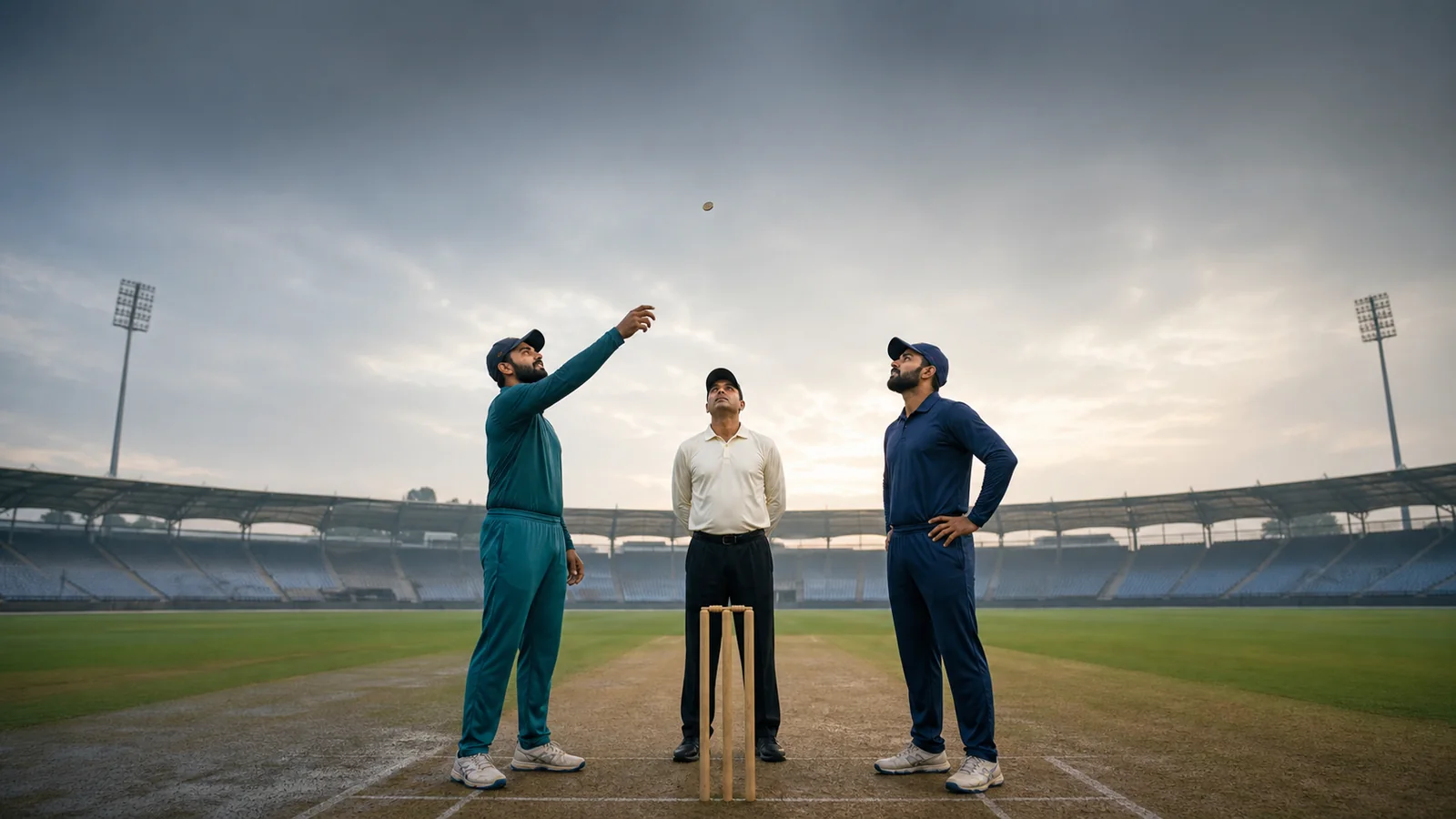
The short answer
MCC Law 13 defines the toss as the choice of innings. The captains toss on the field within the stated pre-match window; the winner decides whether to bat or field and notifies the opposition and umpires. Once notified, the choice cannot be changed. The current referenced ICC Test, ODI and T20I conditions use the same finality, with the ICC Match Referee supervising international tosses. That makes the last inspection and forecast update important, but the Law does not say which tactical choice is better.
What the toss law actually says
Treat the match as a sequence of conditions. The pitch at 9:30 is only one frame: ask what it should be like after the new-ball spell, under afternoon sun, beneath lights, after traffic from bowlers' footholes, and—during a Test—on days four and five. Do the same for cloud, temperature, wind, rain and dew. The best decision compares first-innings conditions with second-innings conditions. A surface can look difficult now and still be even worse later, or look dry now and become easier once moisture leaves the top.
Predict the sequence, not the snapshot
Read visible grass, moisture, firmness, cracks, previous use and footmark areas, then attach a confidence level to each observation. Green colour does not prove dangerous seam; dry appearance does not prove rapid deterioration. Ask the curator only what can properly be shared, inspect warm-ups and note whether the surface is new or reused. MCC Law 9 explains that pitch watering does not occur during the match and specifies limited rolling and maintenance, but it does not predict behaviour. Record the expected direction—improving, stable or deteriorating—plus how certain that call is.
Read the pitch without pretending certainty
Put weather on a clock. Early cloud or moisture matters only if your bowlers can use the new ball before conditions change. Dew expected during the chase usually points toward fielding first: the toss winner bowls before the outfield becomes wetter and bats second while the opponent may have the harder gripping and fielding conditions. But dew is venue- and night-specific, not guaranteed by humidity alone. Rain is also not an automatic chase signal. DLS balances overs and wickets as resources, so interruption timing, wickets lost and minimum-over conditions matter more than a slogan.
Put weather on a timeline
In Tests, batting first is attractive when the surface should wear, spin or develop variable bounce, because it can keep your team away from the most difficult fourth innings. Fielding first needs stronger evidence than a little grass: meaningful early movement, a forecast for improvement, a capable attack and a batting order equipped for the response if wickets do not come. Even the greatest fast bowlers of all time needed conditions and enough time for their method to outweigh fourth-innings risk. Consider five days of weather, not the first session only. An early bowling window may last 15 overs; a deteriorating pitch can shape several innings. Neither principle is a rule, and exceptional moisture or delayed preparation can reverse the normal lean.
The Test-match decision
In an ODI, compare the first ten overs in each innings, the afternoon-to-evening transition, target information and the last-ten-over bowling conditions. A side with skilled new-ball bowlers may field first to attack early; a side with quality spin and a dry surface may want runs banked before defending later. Chasing provides a known target, but it also compresses risk if wickets fall. Batting first removes target pressure but demands a defensible total without knowing the exact benchmark. The best ODI fast bowlers create value only if they receive the phase and conditions their skills fit.
The ODI decision
In T20, a small conditions change can affect a larger share of the match. Field first when a credible dew advantage, strong chase plan and early bowling matchup align. Bat first when the pitch is slowing, boundary defence is a team strength, the batting group attacks without a target, or the opponent's chase is structurally fragile. Do not turn league trends into venue truth. The best T20 fast bowlers, best powerplay field settings and best death overs field settings still depend on whether the ball is dry, gripping, swinging or skidding in the relevant innings.
The T20 decision
An environmental advantage counts only if your eleven can use it. Choosing to field on a seaming pitch gains little when the attack cannot hold a full channel. Choosing to bat on a turning surface may fail if the top order is weakest against spin. Score the fit: new-ball control, spin depth, batting technique, chase method, boundary defence, fielding quality and available bowling order. The best bowling order in cricket preserves the right skills for each phase; the toss should not force a plan your team did not select or rehearse.
Can your eleven exploit the advantage?
Use the opponent as a secondary input, not a substitute for conditions. Fielding first can be stronger when their top order is vulnerable to your exact new-ball method. Batting first can expose a shallow chase or deny their attack the conditions it needs later. Avoid reputation-only choices such as 'they hate chasing' without a current lineup, format and venue sample. The best way to set a cricket field after the toss also follows this logic: the bowling plan must target a real batter-bowler interaction rather than a generic fear.
Use the opponent as a tie-breaker
Venue data can help when it is segmented correctly. Separate format, season, day versus night, pitch strip or surface type, toss choice and team strength. Raw bat-first win percentage mixes captains who selected batting for specific reasons with teams forced to bat after losing the toss; it may also reflect stronger home sides. Older studies reach different average conclusions from different samples, while a large toss study found that the advantage varied with playing conditions. Use recent comparable matches to update a physical read, not to overrule today's pitch and forecast.
How to use venue data safely
Use a confidence-weighted sheet with five rows: pitch trajectory, weather sequence, format incentives, your team fit and opponent asymmetry. For each, mark bat first or field first, confidence from one to three, and the evidence. A dry reused surface pointing to later turn may score three for batting; uncertain cloud earns one for fielding; verified heavy evening dew may score three for fielding; weak chasing depth may score two for batting. Add the weights instead of counting opinions. If one unsupported hunch decides the result, the sheet has exposed the uncertainty rather than hidden it.
A confidence-weighted decision sheet
Strong bat-first signals are a credible deteriorating surface, the clearest batting window at the start, later spin or variable bounce, a team built to set and defend, and an opponent poorly equipped for a chase. Strong field-first signals are substantial early seam or swing, expected later batting improvement, reliable dew during the second innings, a superior chase plan, and a bowling attack matched to the opening conditions. Two or three aligned signals create a decision. One cosmetic green patch, generic final pressure or a forecast app icon should not.
Strong signals to bat or field first
Common mistakes include deciding from format alone, confusing current dampness with future improvement, and treating dew as certain without venue evidence. Captains cite a venue chase rate without controlling for night games or team quality, pick bowling despite lacking new-ball control, or bat first on a surface expected to improve because defeat would look more conventional. Another error is treating rain as a guaranteed DLS chasing edge; DLS changes targets from resources and match state. Finally, some captains announce the choice before confirming the final forecast even though the notified decision is irreversible.
Common toss-decision mistakes
Before the coin lands, prepare both plans. After winning, ask seven final questions: what do Law and competition procedure require; how should the pitch change; when should weather change; which innings receives the better ball and outfield; can this eleven exploit that advantage; what does recent comparable venue evidence add; and how confident is the forecast? If the weighted evidence is tied, choose the plan with fewer fragile assumptions and clearer roles. The best toss decision in cricket is not proved by the result; it is a disciplined choice made from the best pre-match evidence available.