
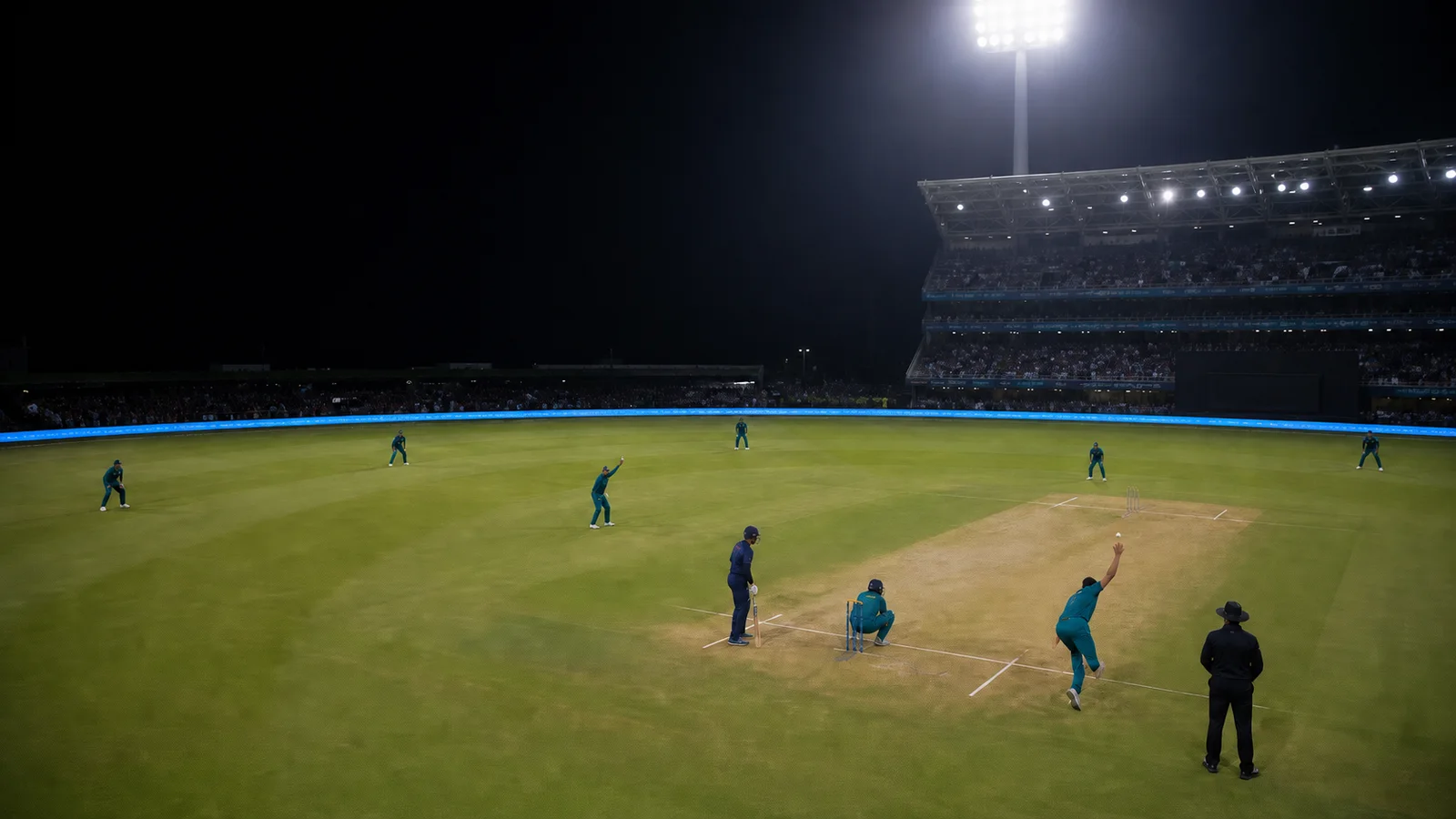
The short answer
Death overs are a tactical planning label, not a single fixed block defined by the Laws. Teams may call the final four, five or more overs the death according to format, wickets and resources. The legal boundary comes from the current playing conditions. In the referenced standard men's T20I non-powerplay and ODI final phase, no more than five may stand outside. ODI overs 41-50 form the standard final phase, but reduced innings alter that timing.
Death overs are a plan, not a fixed rule
Count before every delivery: bowler, wicketkeeper and nine other fielders. With five outside, five non-bowlers—including the wicketkeeper—remain inside. MCC and ICC placement rules still apply, including on-side limits, pitch encroachment and movement. Name all ten non-bowlers rather than drawing five boundary dots and assuming the rest. A death field that accidentally uses six outside can turn a difficult delivery into a no-ball and another scoring opportunity.
The legal and player-count check
For a right-arm wide yorker to a right-hander, place deep third, deep point, deep cover, long-off and long-on outside. Inside use wicketkeeper, point, cover, midwicket and short fine leg. The first four riders protect the planned off-side channel; long-on covers the straight miss and batter reaching across to drag the ball. Deep midwicket can replace long-on against a stronger slogger or a bowler missing shorter. The field works only while the ball remains wide and full.
A wide-yorker field
For a straight yorker, place long-on, long-off, deep midwicket, deep square leg and deep cover outside. Inside are wicketkeeper, point, cover, midwicket and short fine leg. Long-on and long-off protect a low full toss or slightly overpitched miss; deep midwicket and square cover the pick-up and inside edge; deep cover handles room created by a batter backing away. If the bowler repeatedly misses wide, add off-side protection or change the target rather than defending a field the ball never reaches.
A straight-yorker field
A slower-ball plan often uses long-on, long-off, deep midwicket, deep square leg and deep cover outside, with wicketkeeper, point, cover, short fine leg and midwicket inside. These riders cover several common early-swing and mistimed loft arcs, not every clean strike. A wide slower ball may need deep point instead of deep square; a into-the-pitch cutter may need a squarer leg-side catcher. The greatest fast bowlers of all time varied pace, but their fields still depended on line and surface.
A slower-ball field
For hard length, try deep third, fine leg, deep square leg, deep midwicket and deep cover outside. Inside use wicketkeeper, point, cover, mid-off and mid-on. This protects upper edges, pulls, ramps, glides and a mistimed cut while the straight inside field attacks singles. On a slow surface, long-on may replace fine leg if the ball sits up for a front-of-wicket hit. The best T20 fast bowlers need repeatable height; a sequence of slot balls makes this field irrelevant.
A hard-length field
Spin at the death needs an exact stock ball and variation. For off-spin into a right-hander, long-on, long-off, deep midwicket, deep square leg and deep cover can protect the main lofted and sweep arcs, while wicketkeeper, point, cover, midwicket and short fine leg stay inside. Wider off-spin may need deep point; leg-spin turning away may move a leg-side rider to the off side. The best field setting for spin bowling begins with turn direction, not with five familiar boundary names.
A spin field at the death
Against a left-hander, off and leg side reverse but the field should not simply mirror. A right-arm bowler's wide-yorker angle changes, and a batter's access to long-on, deep midwicket and cover depends on stance and crease position. Re-state the primary ball, the likely miss and the longest boundary. Move deep point, cover, third and leg-side riders accordingly. Around-the-wicket delivery creates another geometry, so signal the change before the run-up begins.
How to field for a left-handed batter
If the batter moves early, decide whether to follow, hold the original target or change pace. A batter shuffling across may expose leg stump but also bring a wide ball within reach. Backing away can turn a straight yorker into a hittable full toss outside off. The captain and bowler need a pre-agreed response and field signal. Do not improvise both delivery and field after the run-up starts. One clear contingency is more useful than five unpractised options.
What if the batter moves early?
Use the ground as a sixth defender. Send the batter toward the longer square or straight boundary only when the bowler can repeat the matching line. Wind, slope and a fast outfield can overturn raw distance. Put the best catching boundary fielder where mistimed balls are most likely and the strongest arm where twos are threatened. Riders should start a few metres inside when a catch is likely, but protect the rope when the match equation makes four prevention dominant. Fielders at adjacent boundary zones must also agree who attacks, who backs up and which end receives the throw. A sound map can still concede two runs when both riders wait or throw to the wrong end.
How boundary size changes the plan
Bring a rider inside when the batter is taking an uncontested single, the protected arc is not being used, a new batter offers a catch or the required rate has fallen enough that singles are dangerous. A short extra cover or midwicket can close a release shot; a slip can return for a new batter if the chosen ball still edges. Send the fielder back when boundary probability rises. Stay within the current limit: five outside is a maximum, not a compulsory shape.
When should a rider come inside?
A shortened ODI uses the applicable table to move its final phase; a reduced T20 has its own powerplay and non-powerplay provisions. Umpires and the scoreboard provide the live legal phase. Do not assume the conventional death window or original 41-50 block survives an interruption. The captain should recalculate overs remaining, bowler quotas and boundary needs together. The best bowling order in cricket preserves enough of the correct skill for whatever final phase remains.
Reduced innings and phase changes
Common mistakes include using one field for every delivery, placing six outside, counting the bowler twice, and protecting both wide and straight misses so weakly that neither plan works. Captains chase the previous six, ignore a batter changing crease, or set a slower-ball field while calling full pace. Another mistake is treating the wide yorker as automatically superior without considering wides, reach and execution. Finally, a rider on the rope who never attacks a catch can concede twos as well as boundaries.
Common death-field mistakes
Use a nine-point check: confirm format and legal phase; count keeper plus nine other fielders; name the primary ball; name its miss; choose five or fewer outside arcs; assign the inside single-saving jobs; state the batter-movement response; identify the longest useful boundary; and define the change trigger. After every ball, record whether the plan or execution failed. The best death-over field setting is not a diagram remembered under pressure—it is a rehearsed agreement between bowler, captain, keeper and every fielder under pressure.