
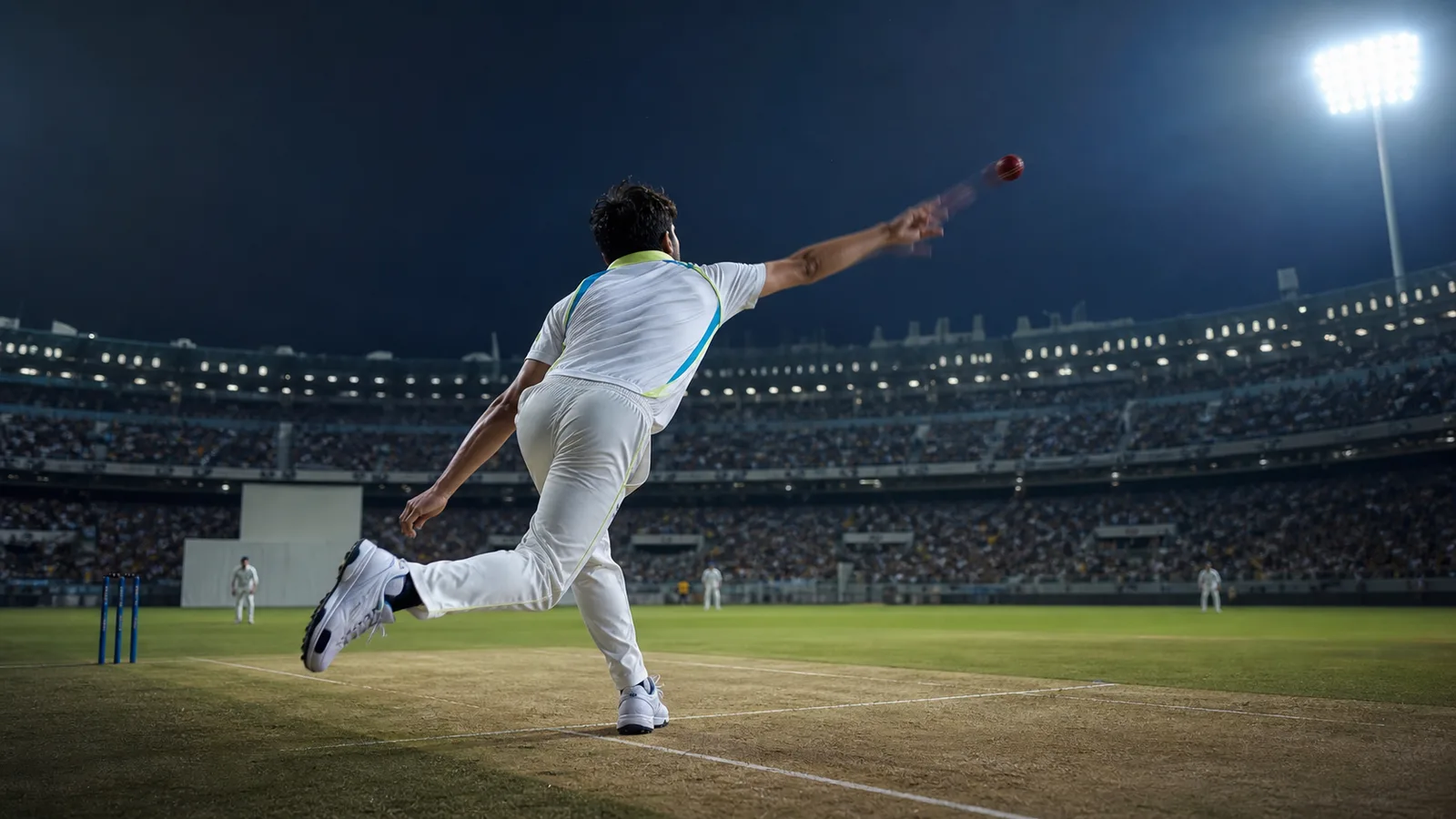
What the speed numbers can prove
This list ranks a single peak delivery, not average pace or career quality. The first question for each entry is whether the number appears in an ICC report, national-board publication, Guinness record or established cricket reference. The second is whether the source identifies the match or setting. That standard gives Akhtar's 2003 ball unusually strong support because the ICC published the host broadcaster's tournament table and Guinness records the same delivery, date and venue. Lower down, several familiar figures come from later compilations. They remain useful, but readers should treat tiny gaps such as 0.2 km/h as reported measurements rather than permanent scientific proof.
The top 10 recorded peaks at a glance
The commonly cited order is Akhtar at 161.3 km/h, Tait at 161.1, Lee at up to 161.1, Thomson at 160.6, Starc at 160.4, Roberts at 159.5, Edwards at 157.7, Johnson at 156.8, Sami at 156.4 and Bond at 156.4. Lee is the clearest example of why a simple table can mislead: the ICC's 2003 World Cup data confirm 160.7 km/h, Wisden lists 160.8 from a later match, and Cricket Australia has cited 161.1. The order follows the highest credible published peak while keeping that conflict visible.
1. Shoaib Akhtar: 161.3 km/h
Akhtar's 161.3 km/h delivery has the deepest provenance in the list. The ICC says host broadcaster Octagon CSI recorded it against England during the group stage of the 2003 World Cup, and Guinness identifies 22 February at Newlands, Cape Town. The ball went to Nick Knight and produced no wicket, which is a useful reminder that a speed record measures release pace rather than the result of the delivery. Akhtar still stands alone at the top because no later reading with comparable public evidence has exceeded 161.3. More than two decades on, that number remains the benchmark used by the ICC and major cricket boards.
2. Shaun Tait: 161.1 km/h
Tait's violent, slingy action produced a reported 161.1 km/h ball against England at Lord's in 2010. Cricket Australia places it second and its player profile calls 161.1 the second-fastest delivery in history. Another ICC report records Tait at 160.7 km/h against Pakistan in Australia earlier that year, showing that he crossed 160 in more than one setting. His short, injury-affected international career does not reduce this specific claim because the ranking asks how fast his best measured ball travelled. It does explain why a peak-speed list and a list of the greatest fast bowlers reach very different conclusions.
3. Brett Lee: up to 161.1 km/h
Lee shares the narrow band just below Akhtar, but published numbers vary. The ICC's broadcaster table from the 2003 World Cup records 160.7 km/h against England. Wisden attributes 160.8 km/h to a 2005 match against New Zealand, while Cricket Australia has written that Lee and Tait were both clocked at 161.1. StumpScope therefore lists Lee as reaching up to 161.1 while treating 160.7 as his clearest tournament reading. That wording matters more than deciding whether he trails Tait by one tenth. The reliable conclusion is that Lee repeatedly operated around the 160 km/h barrier at international level.
4. Jeff Thomson: 160.6 km/h
Thomson's 160.6 km/h figure is extraordinary because it comes from 1975, long before broadcast radar became routine. Cricket Australia and Wisden both repeat the WACA measurement, and contemporary reputation places Thomson among the most frightening bowlers his opponents faced. Yet the method used for a historical timing trial cannot be assumed to match a modern radar reading at the point of release. That does not erase Thomson from the list. It changes how the number should be read: 160.6 is the accepted published peak, but its decimal should not settle a cross-era argument against a bowler measured by different equipment forty years later.
5. Mitchell Starc: 160.4 km/h
Starc supplied the cleanest modern Test-match reading. On 15 November 2015 at Perth, Cricket Australia reported the fourth ball of his 21st over to Ross Taylor at 160.4 km/h. The same report called it a possible Test record and described the rest of the spell, including deliveries around 155 and one that broke Brendon McCullum's bat. The speed did not produce a wicket, which again separates velocity from outcome. Starc's entry also carries an unusually useful caution from the source itself: bowling-speed records are notoriously unreliable. His exact match context is strong, while comparisons with older devices remain approximate.
6. Andy Roberts: 159.5 km/h
Roberts is listed at 159.5 km/h in the Wisden compilation. The figure belongs to the early age of formal pace measurement, so it has less transparent match-level documentation than Akhtar's or Starc's. Cricket West Indies supplies the more dependable career context: Roberts led the rise of the West Indies pace attack and used two different bouncers, one to draw a batter forward and a quicker one to hurry the response. That detail explains why raw speed alone never captured his method. For this page, 159.5 earns sixth place as the commonly published peak; the historical measurement boundary stays attached to it.
7. Fidel Edwards: 157.7 km/h
Edwards reached a widely cited 157.7 km/h against South Africa early in his international career. His low, round-arm release made the ball difficult to pick up, and his best pace arrived before injuries reduced his continuity. Wisden includes 157.7 in its historical top 10, but the accessible evidence trail does not offer the same broadcaster table available for the 2003 World Cup leaders. The responsible description is therefore a compiled peak rather than an independently reconstructed record. Edwards belongs in the conversation because reputable cricket lists agree on the figure, while StumpScope avoids adding unsupported claims about how often he sustained it.
8. Mitchell Johnson: 156.8 km/h
Johnson's accepted peak is 156.8 km/h, recorded during the 2013 Ashes in Australia. The number appears in Wisden's historical list, while the ICC's pace feature confirms that Johnson regularly exceeded 150 km/h during his fastest period. His value in that Ashes series came from more than the speed gun: a sharp left-arm angle, hostile short balls and the ability to repeat high pace made the threat last across spells. This ranking does not award extra places for wickets or intimidation, so Johnson remains eighth on peak speed. The context helps readers understand why a slightly lower maximum could feel more damaging than a faster isolated delivery.
9. Mohammad Sami: 156.4 km/h
Sami's 156.4 km/h entry survives after a more sensational reading was rejected. Some scoreboards and later articles mention 164 km/h, but the reading was treated as a speed-meter fault and does not belong in a responsible record list. Wisden uses 156.4, which places Sami level with Bond in the compiled top 10. This is exactly the kind of case that rewards a source gate: the bigger number attracts clicks, while the credible number fits what recognized cricket publications retain. Sami's genuine pace needs no faulty reading to establish him among Pakistan's fastest international bowlers.
10. Shane Bond: 156.4 km/h
Bond also appears at 156.4 km/h in Wisden's compilation, with the peak associated with the 2003 World Cup period. The ICC's tournament table confirms 153.4 km/h against Canada during the group stage, so the higher number likely comes from another delivery or a later compilation rather than that specific table. Bond combined speed with late swing and accuracy, which helped him take 6 for 23 against Australia in the same tournament. Only the speed determines tenth place here. The wicket-taking context explains why his pace mattered, without using career performance to inflate the measured figure.
Why credible speed lists disagree
Three problems create most disagreements. Sources may cite different matches for the same bowler; broadcasters may measure at slightly different points after release; and older camera or radar setups do not share one calibration standard. Guinness records Akhtar's mark while noting the ICC's view that speed guns lacked enough uniformity for one performance to receive a universal official designation. Modern research reinforces the broader issue: radar placement, device accuracy, balls, run-up, instructions and collection protocols can change reported release speed. A difference of a few tenths should therefore be read as a recorded result, not a proof of physical superiority.
Fastest does not mean greatest
The fastest bowler and the greatest fast bowler answer separate questions. Peak-speed rankings reward one delivery at maximum effort. Career rankings ask whether a bowler took wickets, controlled scoring, adapted to conditions and stayed effective across years. Akhtar leads this speed list, while StumpScope's ranking of the greatest fast bowlers of all time uses a career-based method and reaches a different number one. Lee, Starc, Roberts, Johnson and Bond also show why the distinction matters: each combined pace with other skills, but those skills do not change the reading on the speed gun.
The final verdict
Akhtar remains the best-supported answer at 161.3 km/h. Tait and Lee form the next group around 161, followed by Thomson and Starc above 160 in the major compilations. The lower five complete the familiar historical top 10, with more dependence on secondary compiled figures. A future update should change this order only when a governing body, broadcaster or similarly credible record supplies the delivery, match and measurement context. Until then, the honest conclusion is precise at the top and progressively more cautious below it: cricket has a clear benchmark, but not a flawless all-era laboratory table.